AI-Agent Autoresearch for Catalyst Design
A new project building an AI research agent that runs the hypothesis–simulation–analysis loop on its own, starting with single-atom catalysts for the hydrogen evolution reaction.
Computational catalysis follows a familiar loop: read what others have done, propose a candidate, build and run the calculations, analyze the results, learn from them, and try again. Most of a researcher’s time goes into the repetitive middle of this loop, such as preparing inputs, babysitting HPC jobs, and parsing outputs, rather than into the decisions that matter.
In this new project, we are building an AI research agent that runs this loop on its own. The idea grew out of an experiment where an LLM agent searched for trading signals around the clock, guided by a rulebook in code and a lab notebook of lessons (see the blog post Can an AI Do Research While I Sleep?). I am now bringing the same design to computational modeling.
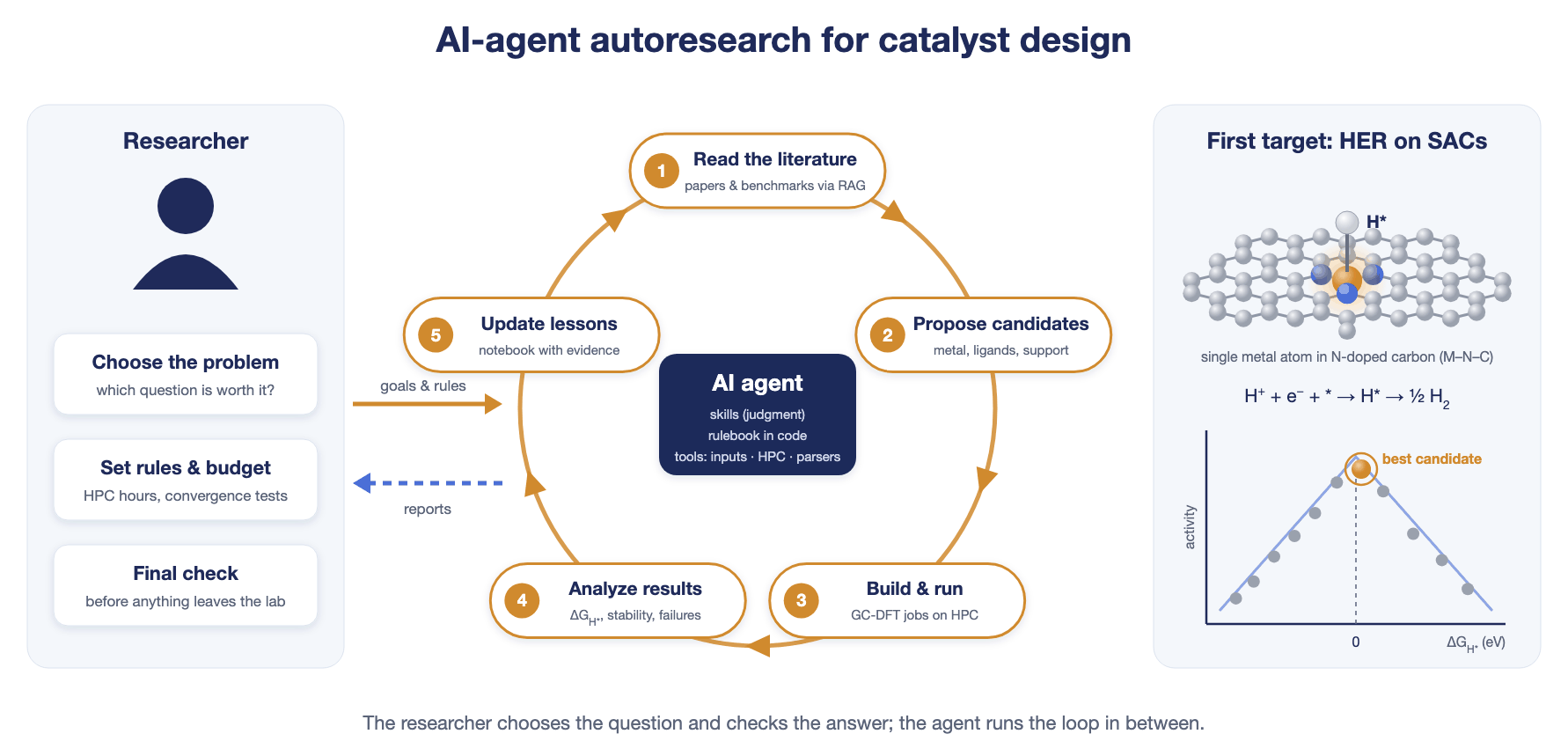
How the agent is built
- Tools (the hands): an input builder that creates and validates calculation inputs, an HPC connector that submits and tracks jobs on the scheduler and can resume after interruptions, and a result parser that catches common failures such as non-convergence or exceeded wall time.
- A rulebook in code: hard limits that the agent cannot override, such as no identical reruns, required convergence tests before a result counts, and a fixed HPC budget.
- Skills (the judgment): step-by-step guidance for generating ideas, improving near misses, and writing reports, in the language of the field.
- A literature library: retrieval over papers and benchmark studies, so the agent starts like a good PhD student, by reading rather than guessing.
- A lab notebook: short, testable lessons with supporting and contradicting evidence, which the agent reads before each new round.
First target: single-atom catalysts for HER
As a first test case, the agent will search for single-atom catalysts (SACs) for the hydrogen evolution reaction (HER). HER is a good starting point because it has a simple, well-established activity descriptor: the hydrogen adsorption free energy, ΔGH*, should be close to zero. At the same time, the design space is large, covering the choice of metal center, coordinating atoms, and carbon support, which is too much to explore by hand.
We will share progress and results here as the project develops.