Role of Interfacial Water Structure in Electrocatalysis
Using ab initio molecular dynamics and machine-learning potentials to study how the electrode potential reshapes interfacial water and, in turn, catalysis on single-atom catalysts.
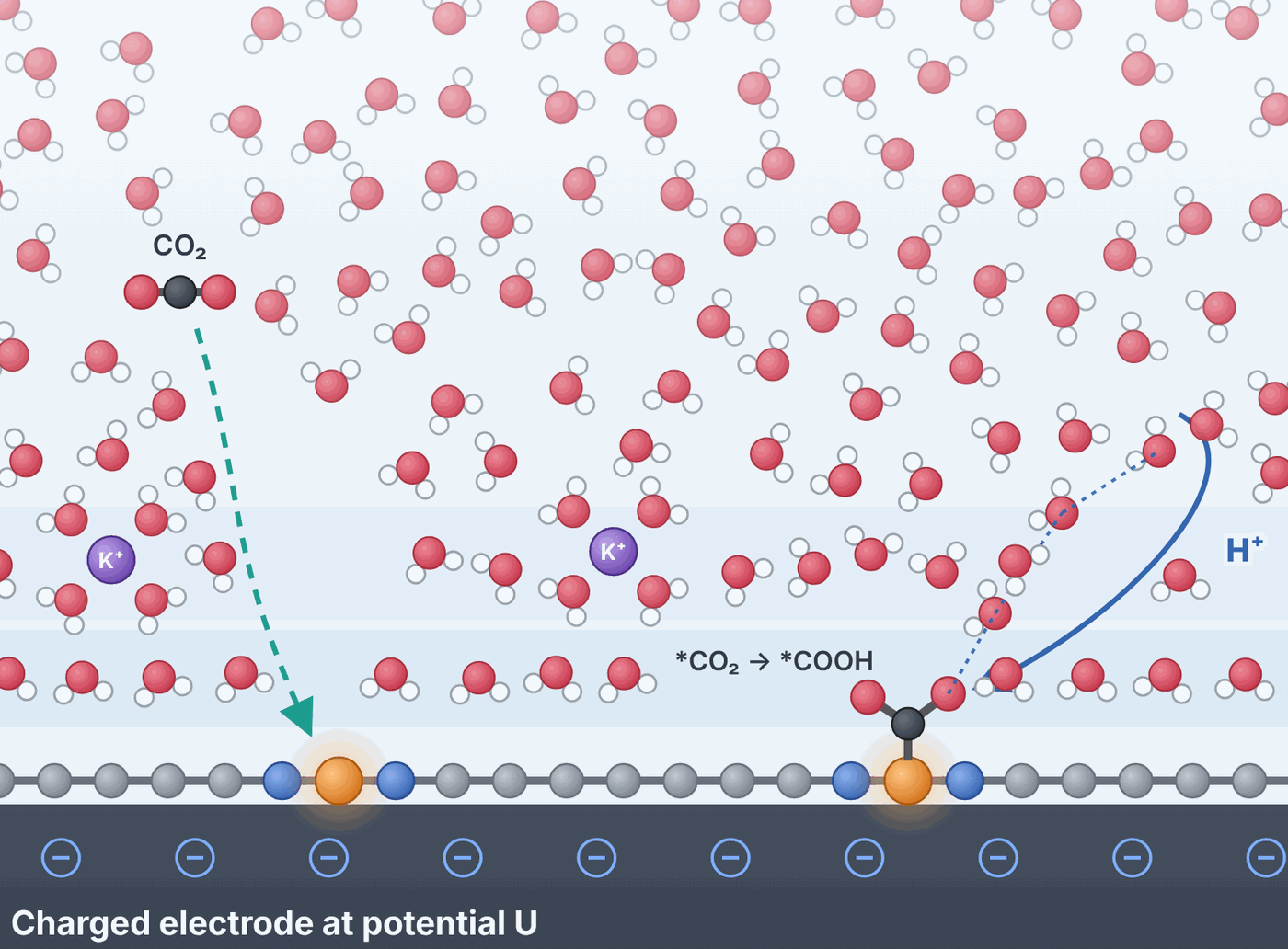
Electrochemical reactions do not happen in a vacuum. They take place at the electrode/electrolyte interface, where the catalyst surface meets a dense, structured network of water molecules and hydrated cations. The applied potential charges the electrode and reorganizes this interfacial water: molecules reorient, hydrogen-bond networks rearrange, and cations such as K+ accumulate near the surface. This microenvironment controls how reactants reach the active site, how protons are delivered, and how stable the catalyst remains [1].
Static models that leave out the solvent, or treat it only as an implicit continuum, cannot capture these effects. We use ab initio molecular dynamics (AIMD) to describe the interface explicitly at the electronic-structure level. We also train machine-learning potentials (MLPs) on AIMD data to reach the larger systems and longer time scales needed for converged structural and dynamical statistics.
Research focus
We focus on three questions about single-atom catalysts (SACs):
- Transport and adsorption. How does the potential-dependent water structure affect the diffusion of reactants such as CO2 to the active site and their adsorption on it?
- Reaction kinetics. How do interfacial water and cations take part in electrochemical steps, for example as proton donors through hydrogen-bond chains, or by stabilizing charged intermediates?
- Catalyst stability. How does the interfacial environment under operating conditions affect the stability of SACs, including degradation of the active site?
References
[1] M. Schreier, P. Kenis, F. Che, A. S. Hall, “Trends in Electrocatalysis: The Microenvironment Moves to Center Stage,” ACS Energy Lett. 2023, 8, 3935–3940. doi:10.1021/acsenergylett.3c01623